I'm not sure why that particular snippet of Latin is the title of this post. Mainly, it just sounded cool. Latin is that way sometimes. It sounds very cool. I see much Latin in my future.
Christmas break is winding down for me. Next weekend, I'll be back at school, frantically searching for all the rest of my books, making sure I know what classes I'm even registered for, and getting used to all those school people again. (Schnykies...the 'o' button on my computer is really dying now. It hardly works at all.) I'll also be moving furniture again, if all goes well. So far, my roommate (or roommates) and I haven't managed to return from a single break without in some way, shape, or form, rearranging the woodstuffs in our room. I don't just mean the little bookcases or something like that, either. I'm talking about the big Correlian ships; beds, dressers, desks, etc.
Anyway, this week I get to visit the dentist and buy a new notebook and things like that. Little items of housekeeping before the long hard road to May is embarked upon. My sister, I think, will in some small way be glad I'm gone. Maybe then I'll stop borrowing her clothes. All her socks have holes in them, by the way, and I didn't put them there. My brother will be glad, in some small way, because it means the keyboard will be at home once more and he can get back to writing music. I don't know about my parents. I haven't asked yet. (-:
Sunday, January 08, 2006

Saturday, January 07, 2006
Prayer of St. Ambrose
(in preparation for Holy Communion)

Lord, Jesus Christ,I approach your banquet table
in fear and trembling,
for I am a sinner,
and dare not rely on my own worth
but only on your goodness and mercy.
I am defiled by many sins
in body and soul,
and by my unguarded thoughts and words.
Gracious God of majesty and awe,
I seek your protection,
I look for your healing;
Poor troubled sinner that I am,
I appeal to you, the fountain of all mercy.
I cannot bear your judgment,
but I trust in your salvation.
Lord, I show my wounds to you.
I know my sins are many and great,
and they fill me with fear,
but I hope in your mercies,
for they cannot be numbered.
Lord Jesus Christ, eternal King, God and man,
crucified for mankind,
look upon me with mercy and hear my prayer,
for I trust in you.
Have mercy on me,
full of sorrow and sin,
for the depth of your compassion never ends.
Praise to you, saving sacrifice,
offered on the wood of the cross for me
and for all mankind.
Praise to the noble and precious blood,
flowing from the wounds of my crucified
Lord Jesus Christ
and washing away the sins of the whole world.
Remember, Lord, your creature,
whom you have redeemed with your blood.
I repent my sins,
and I long to put right what I have done.
Merciful Father, take away
all my offenses and sins;
purify me in body and soul,
and make me worthy to taste the holy of holies.
May your body and blood,
which I intend to receive,
although I am unworthy,
be for me the remission of my sins,
the washing away of my guilt,
the end of my evil thoughts,
and the rebirth of my better instincts.
May it incite me to do the works pleasing to you
and profitable to my health in body and soul,
and be a firm defense
against the wiles of my enemies.
Amen.
courtesy of Women for Faith and Family...
Oh, crumbs.
It has happened. I dreaded the day, and now it's here, and I don't know where to turn. I'm lost, I'm alone, I'm helpless, and there isn't a sympathetic or understanding shoulder within 699 miles.
John was right.
Ugh.
He said to me once that writing was something you disciplined yourself to do--each day you have to make up your mind to just sit down and write something, anything, but to do it whether you felt like it or not. He was right. As long as I had a deadline for posting those twelve days of Christmas, I was on the ball. I was there. I was ready. I was willing.
Now, there's no pressure. And there's also no post. I don't have someone standing over me, asking about the next day, so I'm just resting on my proverbial laurels (I'll be darned if I've figured out where they are, though) and doing nothing. John was right. Ugh.
Friday, January 06, 2006
Adoremus!
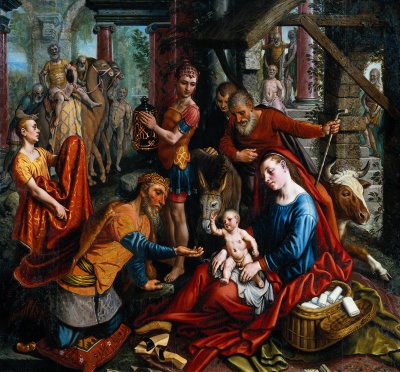 Middle panel of a triptych The Adoration of the Magi; c. 1560; Oil (?) on panel, 167.5 x 179 cm; Rijksmuseum, Amsterdam
The baby Jesus is sitting on the lap of his mother, the Virgin Mary. He is holding his hand up in a blessing. Before him kneels a king offering a gift of gold. This is Melchior, the oldest of the three kings who came to pay homage to the infant Christ. Behind Mary, in a red gown is her husband Joseph. According to tradition, Jesus was born in a stable. The donkey, the ox and the shabby straw roof remind us of this. The scene takes place against the background of a ruined palace with marble columns and steps. This refers to King David, a distant ancestor of Jesus. The ruin is symbolic and represents the old world: Jesus represents the new, Christian world.
Pieter Aertsen painted this large, colourful panel in around 1560. It is a varied scene with many attractive details such as the rather homely basket of clothes beside Mary and the king's entourage with camels on the left of the background.
The Fest of the Adoration of the Magi
The visit of the Magi took place after the Presentation of the Child in the Temple (Luke 2:38). No sooner were the Magi departed than the angel bade Joseph take the Child and its Mother into Egypt (Matthew 2:13). Once Herod was wroth at the failure of the Magi to return, it was out of all question that the presentation should take place. Now a new difficulty occurs: after the presentation, the Holy Family returned into Galilee (Luke 2:39). Some think that this return was not immediate. Luke omits the incidents of the Magi, flight into Egypt, massacare of the Innocents, and return from Egypt, and takes up the story with the return of the Holy Family into Galilee. We prefer to interpret Luke's words as indicating a return to Galilee immediately after the presentation. The stay at Nazareth was very brief. Thereafter the Holy Family probably returned to abide in Bethlehem. Then the Magi came. It was "in the days of King Herod" (Matthew 2:1), i.e. before the year 4 B.C. (A.U.C. 750), the probable date of Herod's death at Jericho. For we know that Archelaus, Herod's son, succeeded as ethnarch to a part of his father's realm, and was deposed either in his ninth (Josephus, Bel. Jud., II, vii, 3) or tenth (Josephus, Antiq., XVII, xviii, 2) year of office during the consulship of Lepidus and Arruntius (Dion Cassis, lv, 27), i.e., A.D. 6. Moreover, the Magi came while King Herod was in Jerusalem (vv. 3, 7), not in Jericho, i.e., either the beginning of 4 B.C. or the end of 5 B.C. Lastly, it was probably a year, or a little more than a year, after the birth of Christ. Herod had found out from the Magi the time of the star's appearance. Taking this for the time of the Child's birth, he slew the male children of two years old and under in Bethlehem and its borders (v. 16). Some of the Fathers conclude from this ruthless slaughter that the Magi reached Jerusalem two years after the Nativity (St. Epiphanius, "Haer.", LI, 9; Juvencus, "Hist. Evang.", I, 259). Their conclusion has some degree of probability; yet the slaying of children two years old may possibly have been due to some other reason — for instance, a fear on Herod's part that the Magi had deceived him in the matter of the star's appearance or that the Magi had been deceived as to the conjunction of that appearance with the birth of the Child.
Read much more on the Magi at Newadvent, or more on the Epiphany Feast. Feliz fiesta!
Read much more on the Magi at Newadvent, or more on the Epiphany Feast. Feliz fiesta!
Thursday, January 05, 2006
On the twelfth day of Christmas...
On the 12th day of Christmas my true love gave to me...
Twelve Drummers Drumming
Twelve Drummers Drumming

The twelve points of doctrine in the Apostle's Creed: 1) I believe in God, the Father almighty, creator of heaven and earth. 2) I believe in Jesus Christ, his only Son, our Lord. 3) He was conceived by the power of the Holy Spirit and born of the virgin Mary. 4) He suffered under Pontius Pilate, was crucified, died, and was buried. He descended into hell. 5) On the third day he rose again. He ascended into heaven, and is seated at the right hand of the Father. 6) He will come again to judge the living and the dead. 7) I believe in the Holy Spirit, 8) the holy Catholic Church, 9) the communion of saints, 10) the forgiveness of sins, 11) the resurrection of the body, 12) and life everlasting.
Wednesday, January 04, 2006
Religion and Patriotism
From many sources there comes the prediction that the future will be far different from the past. Any old order or any new order, if it is to endure, must not ignore the origin, the dignity, the rights and the destiny of man. Church institutions teach and exemplify love of God, love of country, and love of fellowman. These three loves are essentials of religious doctrine, and we believe also that they are foundations of American democracy.
We know our obligations to our country. Gladly do we fulfill them and render our full contribution to the upholding and upbuilding of democracy. As loyal, patriotic, American citizens we have apprehensions of dangers to democracy, dangers from our avowed enemies beyond the confines of our land, and dangers from those within our borders whose concept of democracy is an arsenal of privileges for themselves.
This is a situation which evokes an important consideration. Before this present world war, and for some time preceding it, there were approximately 30,000 fewer French inhabitants in France each succeeding year. During the past decade in the United States the number of persons over sixty years of age has increased almost one-third, which is a great tribute to our doctors, to our scientists and our government. But what is vitally ominous is the fact that the number of children under fifteen years of age decreased and the trend is such that within the next generation there will be more people in this country over sixty years of age than there will be children under fifteen years.
This reflection and others of like import are pressingly ominous challenges to the domestic life of our nation. And they are challenges to our national life, for we cannot win the war for America if we lose the battle for the cradle!
~Francis Cardinal Spellman
The Road to Victory (1942)
On the eleventh day of Christmas...
On the 11th day of Christmas my true love gave to me...
Eleven Pipers Piping
Eleven Pipers Piping
The eleven Faithful Apostles: 1) Simon Peter, 2) Andrew, 3) James, 4) John, 5) Philip, 6) Bartholomew, 7) Matthew, 8) Thomas, 9) James bar Alphaeus, 10) Simon the Zealot, 11) Judas bar James. (Luke 6:14-16). The list does not include the twelfth disciple, Judas Iscariot, who betrayed Jesus.
Tuesday, January 03, 2006
On the tenth day of Christmas...
On the 10th day of Christmas my true love gave to me...
Ten Lords A-leaping
Ten Lords A-leaping
 The ten commandments: 1) You shall have no other gods before me; 2) Do not take God's name in vain; 3) Remember the Sabbath Day; 4) Honor your father and mother; 5) Do not murder; 6) Do not commit adultery; 7) Do not steal; 8) Do not bear false witness; 9) Do not covet a man's wife; 10) Do not covet a man's goods. (Exodus 20:1-17)
Monday, January 02, 2006
On the ninth day of Christmas...
On the 9th day of Christmas my true love gave to me...
Nine Ladies Dancing
Nine Ladies Dancing
The nine Fruit of the Holy Spirit: 1) love, 2) joy, 3) peace, 4) patience, 5) kindness,6) generosity, 7) faithfulness, 8) gentleness, and 9) self-control. (Galatians 5:22)
Sunday, January 01, 2006
Charles Carroll made history as the lone Catholic signer of the Declaration of Independence, but his legacy is all but ignored in today's classrooms.
NASHVILLE, Tennessee, 1 NOV. 2005 (ZENIT)
Scott McDermott, a circulation librarian at Vanderbilt University Divinity School, writer and convert, began studying about Carroll after he came into the Church and wrote about his findings in "Charles Carroll of Carrollton: Faithful Revolutionary" (Scepter).
McDermott shared with ZENIT how Carroll influenced America, and how its Founding Fathers may have unknowingly reinvented the Catholic political tradition.
Part 2 of this interview will appear Wednesday.
Q: Why did you choose to do a biography on Charles Carroll?
McDermott: When I was an undergraduate, prior to my conversion to Catholicism, I studied the American Revolution quite a bit.
The conflict was described almost exclusively in terms of what has been called the "Whig view of history." In this view, all history is seen in terms of linear progress toward maximum personal freedom, of the sort enjoyed by Protestant Englishmen in the 19th century.
Now this is a rather antiquated point of view, which was denounced by such influential 20th-century historians as Sir Herbert Butterfield and Sir Karl Popper.
It was, however, alive and well in history departments in the 1980s, albeit in a different form: Instead of progress toward Anglo-American political institutions, history was interpreted as a gradual struggle for liberation of all
peoples from oppressive "Western" truths and customs.
So, we were given the Whig school in postmodern dress, and the American Revolution was seen not as an affirmation of timeless laws of nature, but merely as an assertion of civil rights.
After my conversion, I became interested in knowing whether the Revolution could in fact be related to the older Christian — and Catholic — political tradition. Charles Carroll of Carrollton, as the only Catholic signer of the Declaration of Independence, was the obvious place to start.
Educated by Jesuits in France, Carroll was steeped in the Catholic political tradition: from St. Thomas, through St. Robert Bellarmine and Francisco Suárez, all the way down to Montesquieu.
His thought clearly reflects Catholic political precepts such as the priority of the common good, corporatism, the liberty of the Church, popular sovereignty, the natural law, and what later came to be called subsidiarity.
But Carroll had to be careful about quoting any of the great Catholic doctors of the Church, because of the taboo against Catholicism in English political life. Carroll brought these ideas into the mix at the time of the Founding, without acknowledging their source.
I've been accused of saying that the American Revolution originated directly from Catholic political teaching. This is obviously not the case; the truth is more complex and interesting.
Catholic teaching was almost totally suppressed in the British Empire in the 18th century. The colonists thought they hated the Catholic political tradition, which they mistakenly identified with the Stuarts' doctrine of divine right. But the Founding Fathers really had no idea what the authentic tradition was.
When they began to resist the king in Parliament, they had to develop a new political science fast.
There was a radical political tradition in England coming from the Puritans, which included the idea of resistance to tyranny; but the Puritan tradition emphasized the supremacy of Parliament, the same Parliament that passed the Stamp Act, and the Townshend Acts and the Intolerable Acts. So the Americans had to dig deeper.
There was the common law, under which laws that violated the natural rights of Englishmen were theoretically null and void. But in spite of the lip service paid by Coke and Blackstone to this theory, the truth was that no judge in England was willing to throw out acts of Parliament, especially those relating to American colonists, on grounds of natural law.
So the colonists had to go back beyond common law, to its roots in the natural law, as proclaimed by Bracton and St. Germain and the courts of equity prior to the Reformation.
I argue that the Founding Fathers unknowingly reinvented the Catholic political tradition. If anyone had suggested to them at the time that that is what they were doing, the Founders would have been horrified. Paradoxically, they were able to revive several elements of Catholic thinking because they were totally ignorant of the authentic tradition.
They also had Charles Carroll in Congress and in the Maryland Senate, pushing them toward Catholic political practice without ever letting on what he was doing. And this is what the Third Plenary Council of Baltimore meant when it said in 1884 that the framers of the Constitution were "'building better than they knew,' the Almighty's hand guiding them."
The results were not perfect, but approximated Catholic political thought in a number of important ways.
Q: How did Carroll use natural law and natural rights in arguing that the colonies were justified in breaking from England?
McDermott: In his "First Citizen" papers of 1773, Carroll argued that it was necessary to move back beyond the common law to the "clear and fundamental" principles of the English constitution, namely the natural law.
Thomas Jefferson's Declaration of Independence cites the "Laws of Nature and of Nature's God" to justify the Revolution, and appeals to the natural rights that derive from the natural law.
At the same time, Carroll was writing his own "Declaration of the Delegates of Maryland" to explain Maryland's vote for independence. Carroll's natural law thinking as expressed in this document complements Jefferson's approach while correcting some of its distortions.
Carroll wrote: "We the Delegates of the People of Maryland in Convention assembled do declare that the King of Great Britain has violated his compact with this People, and that they owe no allegiance to him."
Then he went back and crossed out "of the People." Thus, in keeping with Catholic corporatism, the "Delegates of Maryland" represent the whole body of society, and not just the majority will. Popular sovereignty is not a matter of ongoing revision of the Constitution by majorities, as Jefferson supposed.
Also, Carroll's document stays with the traditional natural rights of life, liberty and property. "Slaves, savages and foreign mercenaries have been meanly hired to rob a People of their property, liberty [and] lives, guilty of no other crime than deeming the last of no estimation without the secure enjoyment of the two former."
Jefferson, of course, substitutes a right to the "pursuit of happiness" for the right to property. By inventing this new right, Jefferson distorted the concept of natural law, with dramatic consequences for the rest of American history.
Maryland's Declaration appeals for its truth "to that Almighty Being, who is emphatically styled the Searcher of hearts, & from whose Omniscience nothing is concealed."
Jefferson's original draft described the natural law as a "sacred and undeniable" truth. Franklin insisted on suppressing even this vague reference to the divine, and so we have the phrase "we hold these truths to be self-evident."
Well, they are self-evident, but they also come from a personal Divine Lawgiver without whom natural law has no meaning.
On the eighth day of Christmas...
On the 8th day of Christmas my true love gave to me...
Eight Maids A-milking
Eight Maids A-milking

The eight Beatitudes: 1) Blessed are the poor in spirit, 2) those who mourn, 3) the meek, 4) those who hunger and thirst for righteousness, 5) the merciful, 6) the pure in heart, 7) the peacemakers, 8) those who are persecuted for righteousness' sake. (Matthew 5:3-10)
Saturday, December 31, 2005
On the Seventh Day of Christmas...
On the 7th day of Christmas my true love gave to me...
Seven Swans A-swimming
Seven Swans A-swimming

The seven gifts of the Holy Spirit: 1) prophecy, 2) ministry, 3) teaching, 4) exhortation, 5) giving, 6) leading, and 7) compassion (Romans 12:6-8; cf. 1 Corinthians 12:8-11)
Friday, December 30, 2005
Oh, ye gods.
"Congratulations! You are most like Bertie Wooster.
I consider this to be a compliment because
Bertie is the sweetest guy out there. He is
the type to help those in need, no matter what
the problem is. The only unfortunate part is
that he doesnt do a good job by himself. Thats
where your pal Jeeves comes in (or a friend who
is a lot like Jeeves)."
On the sixth day of Christmas...
On the 6th day of Christmas my true love gave to me...
Six Geese A-laying

The six days of creation that confesses God as Creator and Sustainer of the world (Genesis 1).
Tank battalion grants 'wish' for 6-year-old
 (Story by Lance Cpl. Lucian Friel)
CAMP LEJEUNE, N.C. (Dec. 20, 2005) -- Most children grow up playing with trucks and tanks, but few of them have the chance to ever experience riding the “Iron Horse.”Thanks to the Make-a-Wish Foundation and the Marines of 2nd Tank Battalion, 2nd Marine Division, that experience came alive for six-year-old Brandon Rasnick of Lehigh Acres, Fla.
Brandon, who was promoted to the rank of sergeant by his fellow Marines, has cystic fibrosis, a genetic lung disorder. Since his one wish was train with Marines and to “save the world,” the Marines of 2nd Tanks arranged a tank display and ride for Brandon.Sgt. Ricardo Fernandez Jr., a tank commander with C Company, instructed Brandon on the M-1A1 Abrams Battle Tank and took him on the ride of his life.“It was great doing something like that for him,” said the San Antonio native. “For us, riding in a tank is not that big of a deal, but seeing the excitement and amazement in his eyes made me realize how important and special it is to some pe
 ople.”
Before taking off on the ride, Brandon got the opportunity to look around the inside and outside of the tank. He learned about where the rounds go to fire the main gun. He was able to look through the sights of the mounted guns, and he learned the basic functions of the tank.“It was so awesome teaching him about the tank,” said Fernandez, a 2002 John Jay High School graduate.
“Seeing the look on his face when I told him certain things about the tank was great.”The 22-year-old father of two explained what it was like for him driving Brandon around the base.“He was a little cold, but he was so excited to be riding in a tank,” he said. “When we were crossing the road, he said to me, ‘All clear tank commander!’ I could tell he was having an awesome time.”
Spending the morning with Brandon and giving him the experience of the “Iron Horse” put a different light on life for Fernandez.“Just seeing this six-year-old fighting through this sickness was amazing,” he said. “It’s tougher than anything we’ll have to do. He’s definitely a warrior and for me it put a different perspective on life. It makes you appreciate everything you take for granted.”This morning was one that Brandon or his fellow Marines will not soon forget.“I’m glad I got a chance to be a part of this,” Fernandez said. “This experience made me feel special, and I will never forget this.” Semper fi.
Thursday, December 29, 2005
Ask and ye shall Get
The popular song "The Twelve Days of Christmas" is usually seen as simply a nonsense song for children. However, some have suggested that it is a song of Christian instruction dating to the 16th century religious wars in England, with hidden references to the basic teachings of the Faith. They contend that it was a mnemonic device to teach the catechism to youngsters. The "true love" mentioned in the song is not an earthly suitor, but refers to God Himself. The "me" who receives the presents refers to every baptized person who is part of the Christian Faith. Each of the "days" represents some aspect of the Christian Faith that was important for children to learn.
However, many have questioned the historical accuracy of this origin of the song The Twelve Days of Christmas. It seems that some have made an issue out of trying to debunk this as an "urban myth," some in the name of historical accuracy and some out of personal agendas. There is little "hard" evidence available either way. Some church historians affirm this account as basically accurate, while others point out apparent historical discrepancies. However, the "evidence" on both sides is mostly in logical deduction and probabilities. One internet site devoted to debunking hoaxes and legends says that, "there is no substantive evidence to demonstrate that the song 'The Twelve Days of Christmas' was created or used as a secret means of preserving tenets of the Catholic faith, or that this claim is anything but a fanciful modern day speculation. . .." What is omitted is that there is no "substantive evidence" that will disprove it either.
It is certainly possible that this view of the song is legendary or anecdotal. Without corroboration and in the absence of "substantive evidence," we probably should not take rigid positions on either side and turn the song into a crusade for personal opinions. That would do more to violate the spirit of Christmas than the song is worth. So, for the sake of historical accuracy, we need to acknowledge this uncertainty.
However, on another level, this uncertainty should not prevent us from using the song in celebration of Christmas. Many of the symbols of Christianity were not originally religious, including even the present date of Christmas, but were appropriated from contemporary culture by the Christian Faith as vehicles of worship and proclamation. Perhaps, when all is said and done, historical accuracy is not really the point. Perhaps more important is that Christians can celebrate their rich heritage, and God's grace, through one more avenue this Christmas. Now, when they hear what they once thought was a secular "nonsense song," they will be reminded in one more way of the grace of God working in transforming ways in their lives and in our world. After all, is that not the meaning of Christmas anyway?"
courtesy of http://www.cresourcei.org/cy12days.html
On the 5th day of Christmas my true love gave to me...
Five Gold Rings
Five Gold Rings

The first Five Books of the Old Testament, known as the Torah or the Pentateuch: 1) Genesis, 2) Exodus, 3) Leviticus, 4) Numbers, and 5) Deuteronomy, which gives the history of humanity's sinful failure and God's response of grace in the creation of a people to be a light to the world.
Wednesday, December 28, 2005
On the fourth day of Christmas...
On the 4th day of Christmas my true love gave to me...
Four Calling Birds
Four Calling Birds

The Four Gospels: 1) Matthew, 2) Mark, 3) Luke, and 4) John, which proclaim the Good News of God's reconciliation of the world to Himself in Jesus Christ.
Subscribe to:
Posts (Atom)